Incontinentia Pigmenti
Introduction
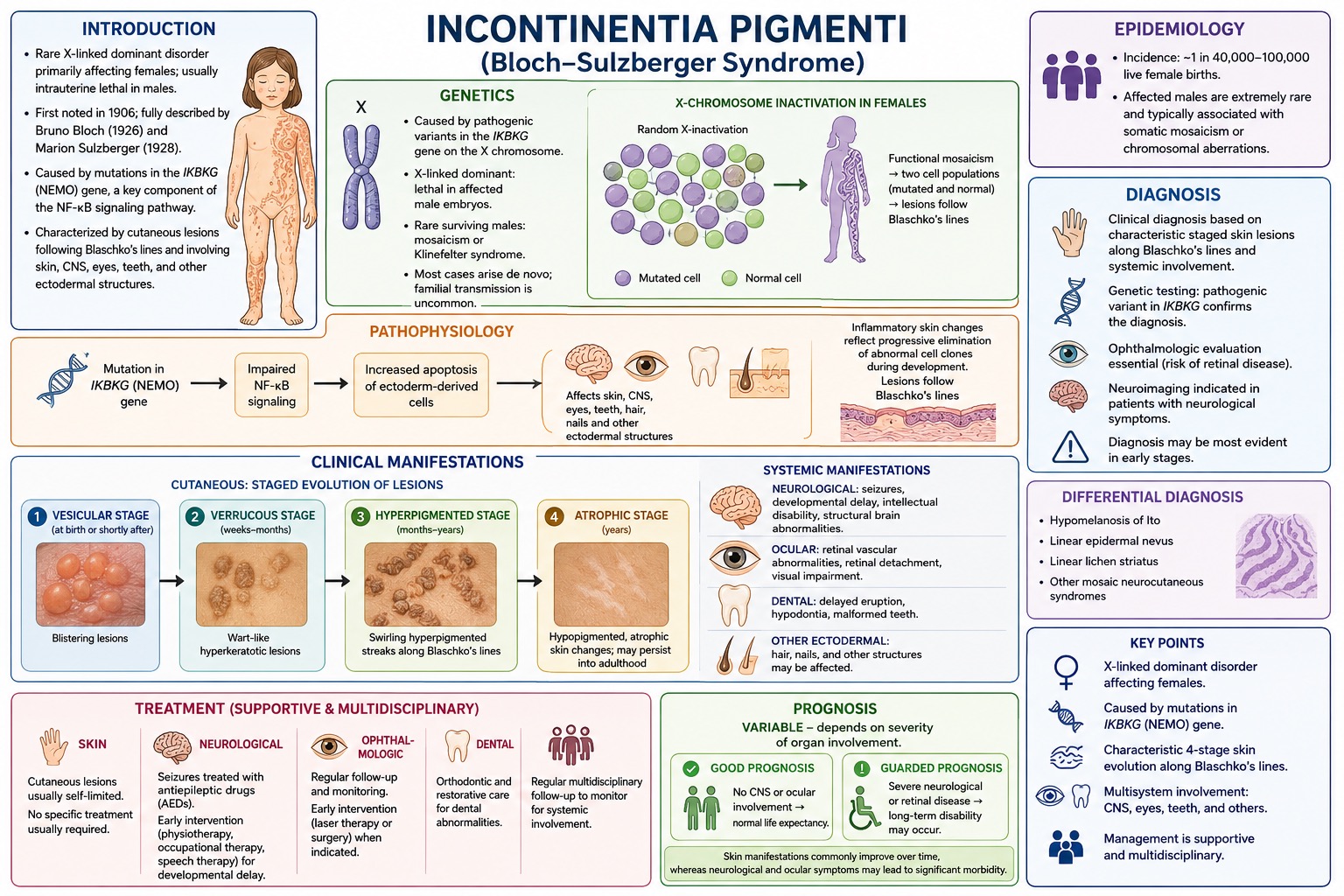
Incontinentia pigmenti (IP), also known as Bloch–Sulzberger syndrome, is a rare X-linked dominant disorder that primarily affects females, whereas it is usually intrauterine lethal in males. It was first noted in 1906. It was fully described by Bruno Bloch (1926) and Marion Sulzberger (1928). The condition is caused by mutations in the IKBKG (NEMO) gene, which plays a key role in the NF-κB signaling pathway, which regulates cell survival and immune function. It is characterized by cutaneous lesions, following Blaschko's lines and progress through different clinical stages.
It presents at birth or in early infancy, with skin manifestations as the first clinical sign. In addition to cutaneous symptoms, IP may involve the central nervous system, eyes, teeth, and other ectodermally derived organs.
Genetics
IP is caused by pathogenic variants in the IKBKG gene located on the X chromosome. The condition is X-linked dominant; therefore, it is lethal in affected male embryos. Although in rare cases, surviving males have been reported in cases of mosaicism or Klinefelter syndrome. Female patients survive due to functional mosaicism resulting from random X-chromosome inactivation. This leads to two cell populations—one carrying the mutation and one normal—resulting in the characteristic Blaschko-linear distribution of skin lesions. Most cases arise de novo, and familial transmission is uncommon.
Pathophysiology
The disease results from impaired NF-κB signaling caused by IKBKG dysfunction, leading to increased susceptibility of ectoderm-derived cells to apoptosis. This pathologic mechanism affects ectodermal tissues, including skin, teeth, eyes, and the central nervous system. The inflammatory skin changes seen in IP reflect progressive elimination of abnormal cell clones during development. The cutaneous lesions follow Blaschko’s lines, which represent patterns of embryonic cell migration.
Epidemiology
Incontinentia pigmenti is rare, with an estimated incidence of approximately 1 in 40,000-100,000 live female births. Affected males are extremely rare and typically associated with somatic mosaicism or chromosomal aberrations.
Clinical Manifestations
The hallmark of incontinentia pigmenti is a staged evolution of skin lesions.
Neurological involvement may include seizures, developmental delay, intellectual disability, and other structural brain abnormalities. Ocular manifestations occur in a significant proportion of patients and may include retinal vascular abnormalities, retinal detachment, and visual impairment.
Dental abnormalities are common and include delayed eruption, hypodontia, and malformed teeth. Less frequently, hair, nails, and other ectodermal structures may also be affected.
Diagnosis
Diagnosis is mainly clinical, based on characteristic, staged skin findings along Blaschko’s lines, often accompanied by systemic involvement. Genetic testing confirms a pathogenic variant in the IKBKG gene, thereby establishing the diagnosis. Ophthalmologic evaluation is essential because of the risk of retinal disease, and neuroimaging is indicated for patients with neurological symptoms.
Because skin lesions evolve, diagnosis may be most evident in the early stages of the disease.
Differential Diagnosis
Differential diagnosis includes other Blaschko-linear pigmentary and inflammatory disorders, such as, hypomelanosis of Ito, linear epidermal nevus, linear lichen striatus, and other mosaic neurocutaneous syndromes.
Treatment
There is no curative treatment for incontinentia pigmenti, and management is supportive and multidisciplinary. Cutaneous lesions are usually self-limited and do not require specific treatment. However, neurological symptoms such as epileptic seizures are treated with antiepileptic medications (AEDs).
Psychomotor developmental delay requires early intervention programs, including physiotherapy, occupational therapy, and speech therapy. Ophthalmologic complications require follow-up, monitoring, and early intervention, including laser therapy or surgery when indicated. Additionally, dental abnormalities require orthodontic and restorative care. In all patients, regular multidisciplinary follow-up is necessary to monitor for systemic involvement.
Prognosis
The prognosis of IP is highly variable and depends on the severity of different organ involvement. Skin manifestations commonly improve over time, whereas neurological and ocular symptoms may lead to significant morbidity. Individuals without central nervous system or ocular involvement generally have a good long-term prognosis and normal life expectancy, while those with severe neurological or retinal disease may experience long-term disability.